
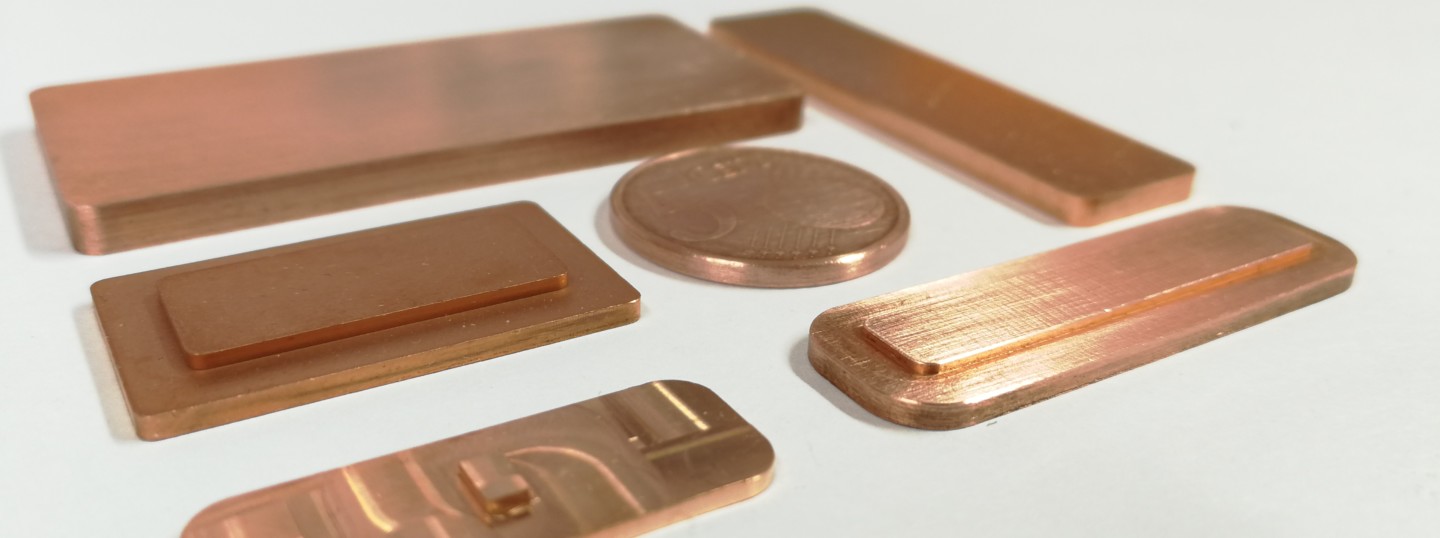
PCB cooling solutions for high-power and heat-critical applications
Aspocomp designs and manufactures thermal management PCBs with integrated PCB cooling solutions for high-power and high-frequency electronics.
From thermal via arrays and metal-backed PCBs to embedded copper coin technologies, we provide engineered solutions that efficiently dissipate heat from critical components, improving performance, reliability and product lifespan.
What is a thermal management PCB?
A thermal management PCB (thermal PCB) is a printed circuit board designed to efficiently dissipate heat generated by electronic components.
PCB cooling refers to the methods used to remove heat through the board structure instead of relying solely on external cooling solutions.
In standard PCBs, FR-4 material has relatively low thermal conductivity. To improve heat dissipation, thermal PCBs integrate highly conductive materials such as:
- Copper (via farms and copper coins)
- Aluminum or copper baseplates (metal-backed PCBs)
These features create a low thermal resistance path, allowing heat to transfer efficiently away from components to a heat sink or surrounding environment.
Thermal management PCBs are essential in applications where temperature directly impacts performance, reliability and component lifespan.
Typical use cases for thermal management PCBs
Thermal PCBs are widely used in applications where efficient heat dissipation is critical.
Telecommunications (5G / 6G)
High-power RF amplifiers and base station electronics.
Power electronics
Motor drives, converters, IGBT modules and high-current systems.
Aerospace and defense
Radar systems and electronics operating in extreme environments.
High-brightness LED systems
LED arrays where heat directly affects efficiency and lifespan.
Key benefits of thermal management PCBs
| Benefit | Description |
| Improved heat dissipation | Integrated PCB cooling solutions efficiently transfer heat away from components. |
| Extended component lifespan | Lower operating temperatures increase mean time between failures (MTBF) and reduce failure risk. |
| Stable electrical performance | Prevents thermal drift and maintains consistent circuit behavior. |
| Compact design | Reduces or eliminates the need for large external heat sinks. |
| Targeted cooling | Enables localized heat removal at critical hotspots. |
PCB cooling technologies and capabilities
Aspocomp offers a wide range of PCB cooling technologies to match different thermal performance and cost requirements.
| Technology | Description |
| Thermal via arrays (via farms) | High-density filled and plated vias (POFV / IPC Type VII) for heat transfer |
| Metal-backed PCBs | Aluminum or copper baseplates for efficient heat spreading |
| Embedded copper coins | Solid copper inserts for extremely efficient localized cooling |
| Hybrid thermal designs | Combination of FR-4 and thermal materials for optimized cost-performance |
| HDI + thermal integration | Combining thermal solutions with advanced PCB technologies |
Benchmark: Embedded copper coin solutions can achieve up to 50% lower thermal resistance compared to via-based cooling in comparable designs.
Thermal PCB design and optimization process
Aspocomp supports a complete thermal design loop from concept to validation.
- Technology selection recommendations
Recommendations between via farms, copper coins or metal-backed structures based on thermal targets. - PCB manufacturing
Specialized processes are used for via filling, metal bonding and copper embedding. - Assembly optimization
Ensures optimal thermal interface between components and PCB cooling structures. - Thermal testing and validation
Thermal measurements and imaging confirm real-world performance.
PCB cooling challenges and how we solve them
| Challenge | Aspocomp Solution |
| High thermal resistance | Optimized cooling structures such as copper coins and metalback PCBs |
| Voiding in thermal vias | Proven POFV process ensures void-free filling |
| Metalback delamination | Controlled bonding and lamination processes |
| Poor thermal interface | Precision manufacturing ensures flat, reliable contact |
| Cost vs performance trade-offs | Engineering support to select the optimal solution |
When do you need a thermal management PCB?
Thermal management PCB is essential when:
- High-power or high-frequency components generate significant heat
- PCB cooling is required to maintain performance
- Space constraints limit external cooling solutions
- Reliability and lifespan are critical design factors
Standard PCB may be sufficient when:
- Power levels are low
- Heat generation is minimal
- External cooling (heatsinks, airflow) is sufficient
Copper coin vs thermal via cooling
| Feature | Copper coin PCB | Thermal via PCB |
| Thermal resistance | Very low | Moderate |
| Heat dissipation | Excellent | Good |
| Manufacturing complexity | Higher | Lower |
| Cost | Higher | Lower |
| Best use case | Extreme hotspots | General high-power cooling |
Frequently asked questions
What is PCB cooling?
PCB cooling refers to methods used to dissipate heat through the circuit board structure using vias, metal cores or embedded copper features.
What is a thermal management PCB?
A thermal PCB is a board designed with integrated cooling features to manage heat in high-power electronics.
What is an embedded copper coin?
A solid copper insert embedded in the PCB to provide a direct, low-resistance thermal path.
What is POFV (Plated Over Filled Via)?
A process where vias are filled and plated over to create a flat, thermally conductive surface for component mounting.
Engineering expertise
Content reviewed by the Aspocomp Engineering Team – specialists in PCB cooling and thermal management solutions since 2002.
Aspocomp has extensive experience in PCB cooling technologies, including metalback PCBs (since 2002), via-based cooling (since 2003) and embedded copper structures (since 2012). Our long-term expertise ensures reliable thermal performance in high-power applications.
Solve Your Thermal Challenges with Engineered PCB Cooling
Our engineers support:
- thermal PCB design
- PCB cooling optimization
- material selection
- manufacturability analysis