
In PCB manufacturing, a board either meets the customer’s specification, or it does not. Between incoming materials, dozens of process steps and final inspection, there are many points where a deviation can appear and many where it can be caught.
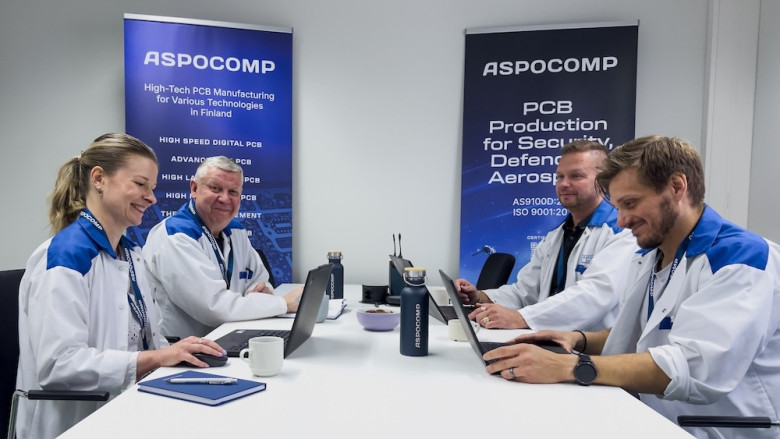
At Aspocomp, the Quality team is responsible for making sure that the boards leaving the Oulu factory match what the customer ordered.
“Quality is not created at the end, once the board is already finished. It is built throughout the whole production process,” says Antti Kangas, Quality Manager at Aspocomp. “We ensure that the products we manufacture meet the requirements by working at the interface between the customer and our production.”
Quality as a Competitive Factor
Quality is also a strategic matter for Aspocomp. In September 2026, Ilkka Lohi joined the company as Quality Director and a member of the management team, an appointment that reflects Aspocomp’s strategy of developing quality and, through it, the company’s business performance.
Lohi brings 20 years of experience from the electronics industry, working with products built around PCBs and assembled boards. His roles have ranged from quality engineer to quality manager, and his experience includes setting up a factory in Hungary, transferring new products into production and auditing suppliers worldwide. Lohi spent much of his career on the customer’s side of PCB manufacturing.
“Our customers design their boards themselves, and those boards go into very demanding operating environments and demanding products,” Lohi says. “The product must last for its entire service life in all kinds of conditions. Aspocomp can manufacture these complex boards and guarantee their quality.”
In his view, Aspocomp’s strength lies in handling a product mix that changes constantly rather than long runs of the same board, combined with manufacturing expertise that supports customers already at the design stage.
Quality Assurance at Every Stage
Boards go through optical inspection covering every inner layer as well as the outer layers, all boards are electrically tested, and cross-sections are taken from every production batch. Before packing, every board is visually inspected against the specification.
The quality team does not carry out these inspections itself. Its role is to make sure the departments that do know what to look for.
“We are not the ones inspecting the boards,” Kangas explains. “We take care of the instructions, we train the departments on the specifications, and we carry out internal audits.”
From Specification to Acceptance Criteria
Every job arrives with a product specification, which often refers to the customer’s general specification and to the IPC class that must be followed. Each department has its own work instructions, and a dedicated tool shows what individual customers require with their deliveries.
“More and more quality reporting is being required,” Kangas says. “The defence sector, in particular, has broader and stricter quality requirements than usual.”
“International PCB standards define the baseline quality level, but almost all customers now have their own requirements on top of them, and those are almost without exception a little stricter than the standards,” Lohi adds. “The number of these requirements keeps growing.”
A specification that does not match what the factory can do is caught at the quotation stage, when documents, Gerber files, and specifications are checked against the factory’s capability.
“If there is something in the design that we cannot manufacture, we can often suggest another way of doing it so that the board becomes easier to produce and still meets the requirements,” Kangas says.
Traceability Down to the Raw Material
In demanding sectors, traceability matters as much as the board itself.
“From a finished board delivered to the customer, we can trace back which production batch it came from, when it was manufactured, when each process step was carried out, who did it, on which machine, and at what time,” Kangas says. “It continues all the way to the raw materials. We can see which material batch a given material came from.”
Every delivery includes a final inspection report and a Certificate of Conformity. Impedance measurement and other reports are agreed case by case, and First Article Inspection (FAI) reports are requested increasingly often.
When Something Goes Wrong
If several boards from a batch must be rejected, Aspocomp opens an internal complaint. A cross-functional group of quality specialists, production management and NPI representatives works out the root cause and plans the corrective and preventive actions.
“Customers value it when even problem situations are sorted out as smoothly as possible,” Kangas says. “We have received positive feedback in customer satisfaction surveys even in cases where there had been a complaint, because the case was handled well together with the customer.”
Certifications and Audits
Aspocomp’s Oulu factory operates under ISO 9001 and ISO 14001 and holds AS9100 certification for the defence sector. Each brings annual surveillance audits, with a broader re-certification audit every three years.
“The AS9100 audit takes a full week, and all the shifts are covered, including the night shift,” Kangas says.
Preparation is continuous: the team runs internal audits and tracks deviations until corrective actions are implemented.
“When we start working with a new customer, they usually want to audit us before larger orders are placed,” Kangas says.
Decades of PCB Experience
“We have a solid understanding of PCBs,” Kangas says. “Jouko has been here since 1983, and I have more than 20 years behind me. We have first-hand experience from many different process stages, and that is a real advantage.”
- Antti Kangas joined Aspocomp in 2004 and has been Quality Manager since 2010, responsible for internal and external quality, quality reporting, and customer and certification audits.
- Jouko Maanselkä has worked at Aspocomp since 1983 and in quality control since 2014, handling internal complaints and reporting and acting as a technical expert for production.
- Miika Venetvaara joined in 2017 and has been a Quality Engineer since 2023, acting as deputy for the Quality Manager. He runs the internal audits and prepares the quality documents customers require.
- Saara Varis joined Aspocomp in 2006 and took on the role of Quality Technician in February 2026, verifying that finished products conform to requirements and handling quality assurance measurements.
- Ilkka Lohi started as Aspocomp’s Quality Director in September 2026 and is a member of the management team.
Spotting Problems Before They Happen
Aspocomp is currently investing heavily in new production equipment, and for Lohi, a clear priority for the coming year is to realise the full capacity and quality benefits of those investments. Beyond that, the focus is on the quality customers experience and on internal quality across all functions.
“We want quality to be a central and visible part of everything we do, throughout the organisation, in the office as well as in production,” Lohi says. “We want our operations to be predictable and systematic so that we can focus on prevention and spend far less time running after fires.”
Getting there, he says, means identifying the critical variables in each process, measuring them continuously and being ready to react to what the data shows before a problem has materialised.
Digitalisation is expected to help by making large data sets easier to analyse.
“We understand how important quality is to our customers. The board must work in their product, and we are committed to meeting their requirements,” Lohi says. “We keep developing our expertise across the organisation, we invest in both production and inspection equipment, and we want an open dialogue with our customers.”
Planning a PCB project with demanding quality or documentation requirements?
Contact Aspocomp to discuss how our quality experts can support you from specification to delivery.