
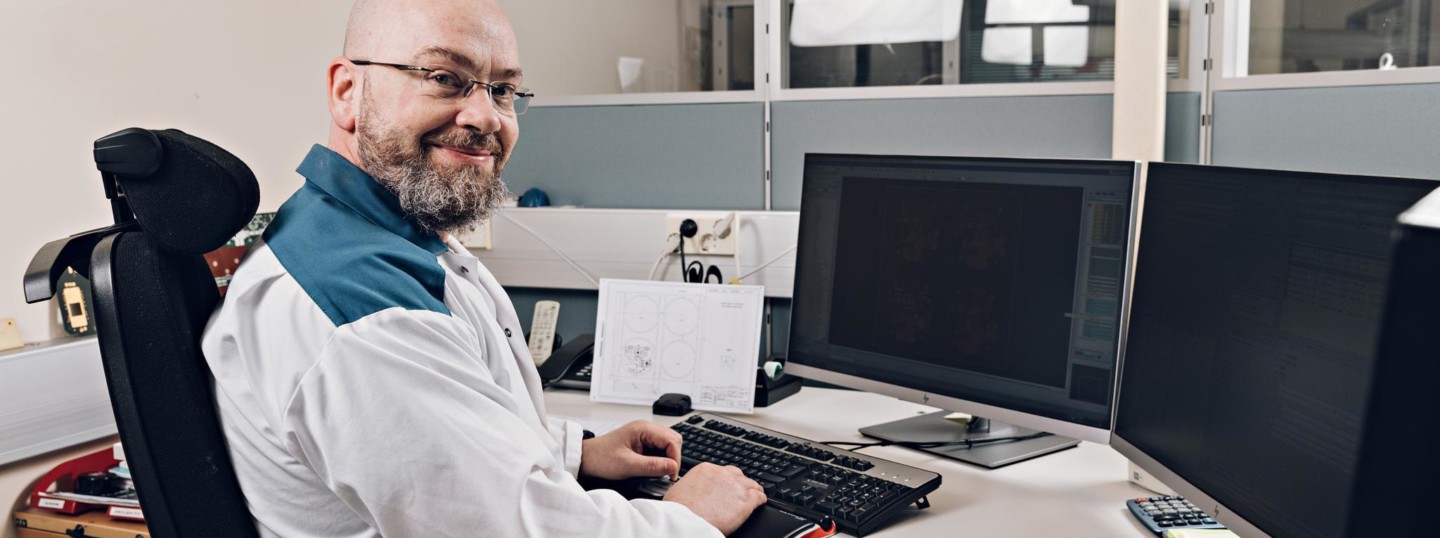
Engineering co-design from the people who actually build your boards
Most PCB suppliers offer “design support”. In practice, this often means a separate consulting team — or a subcontracted reviewer — who never sees the production floor. Issues caught in design review are translated through a margin layer before they reach the people who actually run the lamination press.
At Aspocomp, the engineer assigned to your account is the same engineer who reviews your design at production stage — working from our Oulu, Finland facility. Microvia manufacturing has been continuous at this facility since 1998. Radio Frequency (RF) laminate processing since 1985. Thermal management technologies since 2002. This is the depth of accumulated production experience your design has access to when we review it.
→ Talk to an engineer about your design.
What design support actually involves
Design support is not a single deliverable. It is a series of conversations, document reviews and design iterations spread across the development cycle. The most common engagements look like this:
Stack-up consultation (early stage)
Before layout begins, we review the proposed stack-up — layer assignment, dielectric thicknesses, material grades, controlled-impedance targets — and propose alternatives that often reduce material cost or improve manufacturability. Typical engagement: 1–2 sessions, 2–4 hours of engineering time.
Material risk and selection
Specialty laminates have variable supply lead times. Our laminate supplier relationships (Rogers, Panasonic, Isola, Taconic, ShengYi etc.) give us advance visibility into availability. We flag designs that depend on at-risk materials and propose qualified equivalents before designs are locked.
DFM review (pre-production)
Before a design moves to production, our engineers review Gerbers, drill files, impedance requirements and stack-up against our manufacturing capability. Issues are categorized as “will cause yield loss”, “may cause yield loss” or “acceptable but suboptimal”. Each is documented with the recommended fix.
Iterative co-engineering (full programs)
For larger programs, we engage from concept through volume production — joining design reviews, contributing to architecture decisions, and carrying design intent into the production location. Same engineers throughout the lifecycle.
Case examples
|
Case 1 — Stack-up cost optimization Customer: European industrial sensor manufacturer developing a high-speed signal acquisition module |
|
Case 2 — DFM intervention before production Customer: Aerospace defense subsystem manufacturer |
Note on cases: These case examples are illustrative. Anonymized references to actual customer projects can be added once cleared by the relevant accounts.
How we engage with you
Design support at Aspocomp is not structured as a menu of priced engagements. It is structured around a single relationship: a named technical contact who knows your products, your design history and the conversations you have had with us before.
Your named technical contact is an Aspocomp engineer assigned to your account. They handle stack-up reviews, material questions and DFM feedback for your designs. They are the same person across projects — so the context built over your first design carries into your second, third and tenth.
The NPI team is activated when a new product moves from design into production. NPI engineers handle the technical transfer between your design intent and our manufacturing process — running first builds, identifying issues that only appear at production volume, and stabilizing the design before serial production begins.
The relationship is built to last. Most of our customers have worked with the same technical contact across multiple product generations. We do not optimize for one-off projects; we optimize for the working relationship that survives a product portfolio’s full lifecycle.
Frequently asked questions
When in the design cycle should I engage your team?
The earliest impact comes at the schematic and stack-up planning stage, before layout begins. Your named technical contact can engage at any stage — even on completed designs as DFM-only reviews. The later the engagement, the narrower the design space available to optimize.
Is design support included with manufacturing orders?
Design support comes with the customer relationship rather than being priced as a separate service. Your named technical contact handles ongoing design questions, stack-up reviews and DFM feedback as part of the working relationship. The NPI team is activated when a new product moves into production.
Will you sign an NDA before reviewing our design?
Yes. NDA execution is typically the first step of any design engagement. We routinely operate under customer NDAs for aerospace, defense and commercial programs.
What design tools and file formats do you support?
Gerber RS-274X, ODB++ and IPC-2581 are accepted. Designs from Altium Designer, Cadence Allegro, Mentor Xpedition and KiCad are common in our review queue.
Can you support a design that will be manufactured elsewhere?
Yes — engineering consultation can be scoped independently of manufacturing commitment. The strongest value comes when our engineers also handle the prototype production, since design intent transfers without translation loss.
Do you provide signal integrity simulation?
We support impedance calculation and stack-up modeling. Full SI/PI simulation is typically handled by the customer’s design tools, but we advise on simulation results and recommend stack-up adjustments based on impedance requirements.
What happens if your DFM review finds issues we disagree with?
DFM findings are recommendations, not mandates. We document each finding with severity, root cause and proposed mitigation. The customer decides which to implement. We will, however, note any findings the customer chooses not to address before production starts.
How does design support relate to AS9100 compliance?
Design support engagements for aerospace customers are documented under our AS9100 quality system. Design records, review minutes and DFM analyses are maintained as part of project traceability.
Related services and products
- Quick-Turn PCBs — fast prototype production once your design is finalized
- Global Supply Services — production transition from prototype to volume in EU or Asia
- Advanced HDI PCBs — design support for fine-pitch and miniaturized layouts
- High-Frequency PCBs — Radio Frequency (RF) material selection and stack-up advisory
Talk to an engineer
A 60-minute consultation is the most common starting point. We review your design or planned project and assign a named technical contact who will work with you across the project’s lifecycle.
About our engineering team
The Aspocomp engineering team operates from our PCB production facility in Oulu, Finland. Continuous PCB production at this facility since the 1970s. Microvia and HDI technology development since 1998. Radio Frequency (RF) laminate processing since 1985. Customer engagements are run by named technical contacts supported by our NPI team for new product introductions. Certifications: AS9100, ISO 9001:2015, ISO 14001:2015.